
 by
by 
I had just pumped gas and pointed the truck toward my son’s school — a 25-minute drive — so I did what I always do and pulled up YouTube for the ride. And there it was. Ohhh crap. What?! I’ll be honest with you: I thought it was fake. I don’t normally stop the world for a headline, but this time I could not believe my eyes.
See, just the day before, I’d been listening to a guy in Cleveland say he keeps asking the Browns’ GM, every time he sees him, whether they’re shopping Myles Garrett. And I’m sitting there thinking, man, leave that man alone, let him do his job — you are not trading Myles Garrett. Even when a Cleveland analyst floated that moving him “would be a good idea,” my honest reaction was: sure, it might be — but I’m not handing over three first-round picks for him. Two firsts and a really good player, tops. He’s getting older, there’s injury risk, that’s it. Talk me into three? Maybe, because Myles is just that guy. But I’d start at two.
Then it happened. And it wasn’t the Cowboys (more on my broken Cowboy heart in a minute). It was the Rams. The Los Angeles Rams. And now? They are scary. Really, really scary. Let me walk you through the whole thing — the deal, the why, and both sides of it — because this one hits different.
The Trade in Black and White
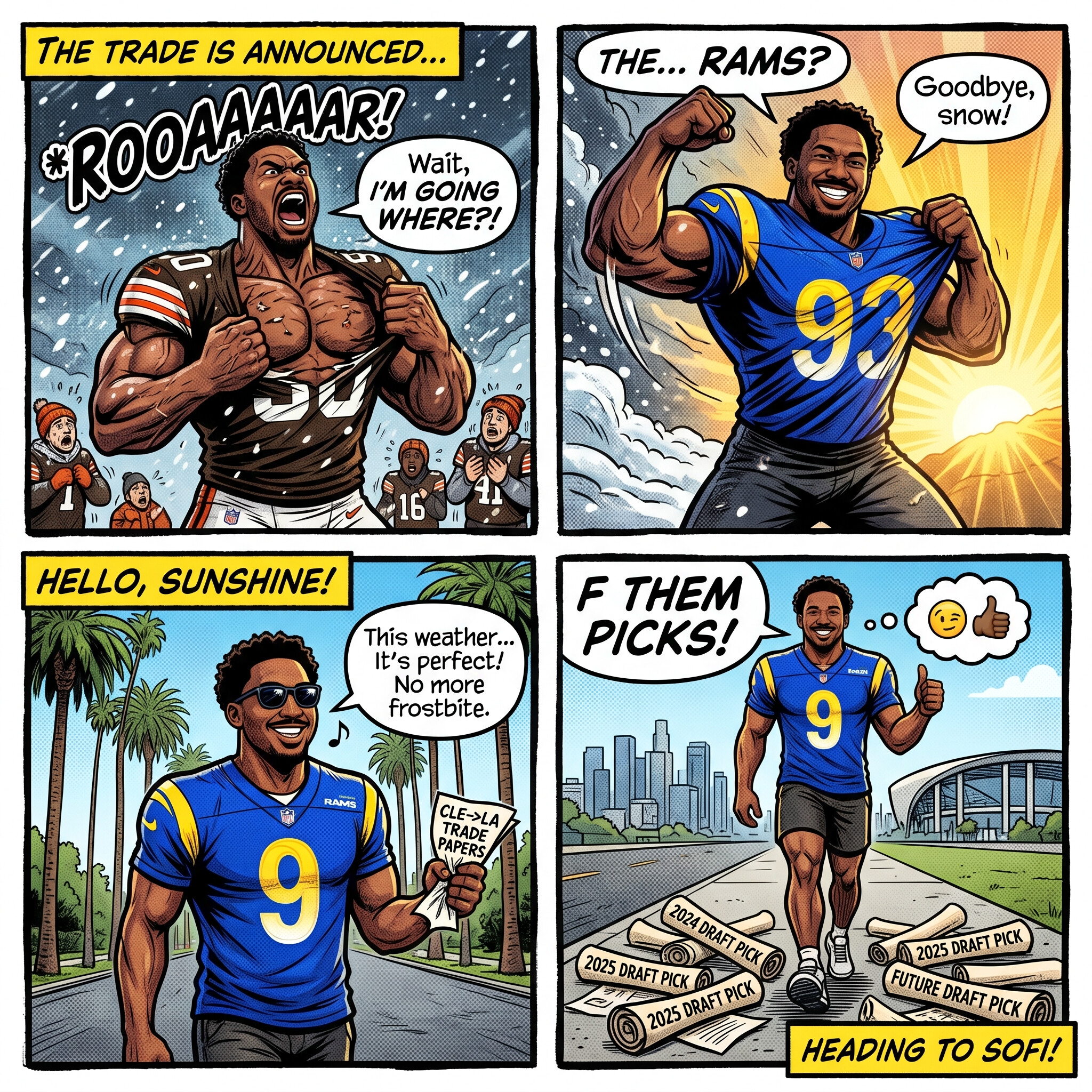
On Monday, June 1, 2026, the Cleveland Browns agreed to send Myles Garrett to the Los Angeles Rams. It was first reported by NFL Network’s Ian Rapoport and Tom Pelissero and ESPN’s Adam Schefter, then made official by both teams. Here’s the deal, clean and simple:
Rams receive
Myles Garrett Edge rusher · 2× NFL Defensive Player of the Year · reigning single-season sack king
Browns receive
Jared Verse (Pro Bowl edge rusher)
2027 first-round pick
2028 second-round pick
2029 third-round pick
My favorite wrinkle? Not long ago, Browns GM Andrew Berry said publicly he wouldn’t move Garrett for two first-round picks. The final return wasn’t even two firsts — it was one first, a second, and a third — plus a young, ascending Pro Bowler in Verse. And per ESPN, Cleveland reportedly clears around $30 million in cash in the process. Read that however you want, but the Browns clearly decided the player value plus the savings beat the pick haul they once held out for.
Who Is Myles Garrett? The Résumé
If you’re new to the rivalry, understand what Cleveland just shipped out. Garrett went No. 1 overall in the 2017 draft out of Texas A&M — into a Browns season that finished 0-16, by the way — and he leaves nine years later as one of the most dominant defensive players the league has ever seen. The man is the Browns’ all-time sack leader and the reigning, two-time Defensive Player of the Year. You can scroll his career page all day, but here are the numbers that matter:
- 125.5 career sacks in 9 seasons — the most in Browns history
- 23 sacks in 2025 — a new NFL single-season record, topping Michael Strahan’s 22.5 from 2001
- 2× Defensive Player of the Year (2023 and 2025)
- 7× Pro Bowl · 5× First-Team All-Pro
- First player since 1982 with 12+ sacks in six straight seasons (2020–25)
- The only player with 10+ sacks in each of the last eight seasons (2018–25)
That’s not a “good player.” That’s a generational, first-ballot, walk-into-Canton talent. Which is exactly why this trade short-circuited my brain on I-64.
The Night Cleveland Won’t Forget
Before we talk about the player he became, let’s tell the story of the night he almost derailed it — because younger fans may not even know it happened. November 14, 2019. Thursday Night Football. The Browns were closing out a 21-7 win over the rival Steelers when, in the final seconds, Garrett wrestled quarterback Mason Rudolph to the ground after a short throw, ripped off Rudolph’s helmet, swung it, and struck him on top of the head. Both benches emptied. It was ugly.
The NFL came down hard. Garrett drew what was, at the time, the longest suspension for a single on-field act in league history — gone for the rest of 2019 and the playoffs, with reinstatement not coming until 2020. He owned it publicly, called it a terrible mistake, and apologized to Rudolph, his teammates, and the organization.
And here’s the thing — we mostly forgot. Not because it wasn’t serious, but because of who Garrett became afterward. The man who lost his cool in 2019 turned into a back-to-back-caliber Defensive Player of the Year, a single-season sack record holder, and a respected leader. Different player. Different man. That growth is a big part of why a contender like the Rams felt good betting real draft capital on him.
Why Cleveland Pulled the Trigger — The Browns’ Side
Let’s be fair to Cleveland, because there’s logic here. For all of Garrett’s individual greatness, the team almost never won. The Browns made the playoffs just twice in his nine seasons (2020 and 2023), with a single postseason win, and they bottomed out at 3-14 in 2024. Greatness on a treadmill.
Then there’s the ghost in the building: the Deshaun Watson trade. Back in March 2022, the Browns sent three first-round picks (2022, 2023, 2024) plus more to Houston and handed Watson a fully guaranteed five-year, $230 million contract — a record for guarantees at the time. What did they get? Watson served an 11-game suspension amid more than two dozen misconduct allegations, battled injuries, and played in just 19 games over three years. Ownership eventually called it a “swing and miss.” It is widely regarded as one of the worst trades in NFL history.
Now sit with the irony, because this is the part that really got me. The analytics that told Cleveland to mortgage the future on Watson blew up in their faces. And now the analytics are telling them to trade their best defender and re-roll the whole roster. Call it the reverse-Rams: instead of trading picks away to win now, you ship out a star to get the picks and start fresh. After the Watson disaster, you Browns needed them picks. Badly.
The personal timeline lines up too. Back in February 2025, Garrett requested a trade, citing his desire to win. The Browns answered in March 2025 by making him the highest-paid non-quarterback in NFL history (four years, $160 million, about $40 million a year), and the tension seemed to cool. But a contract restructuring this past March, plus Garrett’s absence from the team’s 2026 offseason program, kept the questions alive — and then the Rams called, and didn’t stop calling. Berry’s long-stated dream of Garrett going “from Cleveland to Canton” finally cracked.
And the player they got back isn’t just paper. Jared Verse is a 2024 first-round pick who’s already a two-time Pro Bowler, a Dayton, Ohio kid coming home, and — crucially — he’s on a cheap rookie contract that doesn’t even become extension-eligible until after this season. For a rebuild, a young, ascending, inexpensive edge rusher is a genuinely smart centerpiece. The Browns have had decent drafts the last couple of years; pair Verse with a 2027 first, a 2028 second, and a 2029 third, and you’ve got the bones of a reset.
Why the Rams Did It — All-In at SoFi (Again)
Now flip the tape. The Rams have a famous front-office mantra — the polite version is “forget them picks” — and they live by it. Here’s the kicker that makes this so dangerous: Super Bowl LXI is being played in their own building, SoFi Stadium, this February. They are running the exact same playbook that already won them a title once before.
Hand Sean McVay and his defense the best edge rusher in football, and you’ve turned a good unit into a frightening one. The move that quietly made it possible? The Rams used a 2026 first-round pick on quarterback Ty Simpson — a selection that raised eyebrows at the time — and with 38-year-old Matthew Stafford’s succession plan now in place, they could afford to ship future first-rounders out the door without losing sleep over their next franchise quarterback. McVay reportedly wasn’t thrilled about all the QB chatter in the spring. Funny how that works out. He has to feel pretty good right about now.
The Stafford Blueprint: From “Stat Padford” to Champion
This is the comparison I keep coming back to, and the Pat McAfee crew nailed it on the air: this is the Matthew Stafford story all over again.
Go back to January 2021. The Rams traded for Stafford, sending Jared Goff plus two first-round picks and a third to Detroit. At that point Stafford had spent twelve years with the Lions, gone 74-90-1, and never won a single playoff game. The doubters were loud. Detroit columnist Rob Parker even hung a nickname on him — “Stat Padford” — the idea being that Stafford piled up empty numbers in garbage time while going something like 10-66 against teams with winning records. People genuinely did not see a champion there. If they had, somebody would’ve traded for him years earlier.
Then Stafford goes to L.A. and wins Super Bowl LVI — at SoFi — in his very first season. Legacy rewritten overnight.
Here’s my honest take. The Garrett-to-Stafford parallel is fair, but Stafford takes the cake, and it’s not close. Nobody wanted to trade for Stafford for over a decade — the doubt was about the player himself. With Garrett, nobody has ever doubted the player. Not once. The only question mark on his entire résumé is whether he’d ever get the chance to win. If he lifts a Lombardi in L.A., he fills in the one blank line he’s got left.
That’s why I’m happy for him. He told us exactly what he wanted, took heat for it, and stayed true to it. You can read his original trade-request statement here — it reads completely differently today.
The Bigger Picture: Pass Rushers Are the New Currency
Zoom out and this trade fits a pattern that’s reshaping the league. It’s being measured against last summer’s Micah Parsons blockbuster, when the Cowboys shipped Parsons to Green Bay for two first-round picks and defensive tackle Kenny Clark, after which Parsons signed a record-setting four-year, $188 million extension.
For my fellow stat-heads, chew on this one: since 2021, Parsons owns the NFL’s best pass-rush win rate at 30%, and guess who’s right behind him at 26%? Myles Garrett. The two best pure rushers of this era. And the money keeps climbing — Garrett reset the non-QB market at $160 million, and Parsons promptly blew past it at $188 million.
Now let me get personal, because this is where it stings. As a Cowboys fan, I was sitting in that truck hoping Dallas would be the team to land Garrett. I liked the sound of it. But here’s the gut-punch: my Cowboys had already traded away their own version of Garrett — Parsons — the summer before. We got out of the elite-edge business right before the price of a championship went up, and then watched the Rams zig while half the league zagged. That’s a tough pill.
The lesson for where the NFL is heading: elite edge rushers are now franchise-altering trade chips, treated almost like quarterbacks. When one becomes available, contenders empty the vault. Expect a lot more of these.
What’s Next: Two Teams, Two Clocks
These franchises are now running on completely different timelines, and both are defensible. The Rams are win-now, right now, with a defense that just jumped from good to terrifying and a home Super Bowl on the calendar. The Browns are a genuine reset — Verse plus three premium picks — while they sort out a messy quarterback room.
And Garrett? He’s finally free to chase the one thing Cleveland could never hand him.
Good for Myles. He’s Free.
I feel for Browns fans — I really do. You lost a legend, the face of your franchise. But you also walked away with hope: real draft capital and a young stud in Jared Verse. That’s the strange, bittersweet pain of being a Browns fan — you lost something, and somehow gained more at the very same time.
As for Myles? Good for him. The man is free. He stood in front of the cameras, told the world he wanted a championship over a quiet trip to Canton, and then he lived it. I’m genuinely, fully happy for the guy. Now go get it in L.A.
What do you think — did Cleveland win the future, or did the Rams just buy themselves a parade? Drop your take in the comments. I want to hear it.


Leave a Reply